If you’ve ever
wondered where "way down upon the Suwannee River" is, you’ll find
it right here in North Central Florida’s spring-fed oasis of
unscathed beauty. Sandwiched between the Suwannee and the Santa Fe
rivers, this region lays claims to more than 100 springs,
unadulterated wilderness, rich recreational possibilities,
friendly river towns, old-time festivals and intriguing historical
sites.
Lake City lies at the
crossroads of Interstates 10 and 75, making it a convenient access
point to the region. It offers the best variety of accommodations
and restaurants in the area.
One soon leaves behind the rush of the freeway upon entering
Columbia County, known as the Freshwater Capital of America. Just
off the interstate, stop at the Columbia County Tourist Welcome
Center and Florida Sports Hall of Fame, the state’s official
sports memorabilia museum covering everything from bowling to auto
racing. The Columbia County Historical Museum resides in a
circa-1870 home furnished in keeping with the period and
displaying artifacts pertaining to local Civil War lore. Nearby,
the Olustee Battle Festival reenacts an important battle each
February.
Lake City is the gateway for canoeists, cyclists, bird watchers,
campers, hunters, horseback riders and fishermen who make their
way to the 200,000-acre Osceola National Forest and other park
lands. The Forest’s Ocean Pond Campground sits on the north banks
of a blue water lake with a beach and boat ramp. A picnic area and
sandy beach called Olustee Beach face it across the 1,760-acre
Ocean Pond lake.
 White
Springs is home to the state’s Nature & Heritage Tourism
Center, which disseminates information on outdoor activities, and
to Stephen Foster Folk Culture Center State Park. The latter
maintains a Stephen Foster Museum and carillon tower that gongs
out his famous compositions. All here is far removed from the "sad
and dreary" world of which Stephen Foster, who never laid eyes on
the Suwannee River, wrote. Its village of old-time craftspeople
stages candle making, blacksmithing and such demonstrations, and
every May the park hosts the Florida Folk Festival, along with 15
other annual special events. Once a health spa, White Springs
tells its history in a downtown walking tour that takes in more
than 20 vintage buildings and sites. White
Springs is home to the state’s Nature & Heritage Tourism
Center, which disseminates information on outdoor activities, and
to Stephen Foster Folk Culture Center State Park. The latter
maintains a Stephen Foster Museum and carillon tower that gongs
out his famous compositions. All here is far removed from the "sad
and dreary" world of which Stephen Foster, who never laid eyes on
the Suwannee River, wrote. Its village of old-time craftspeople
stages candle making, blacksmithing and such demonstrations, and
every May the park hosts the Florida Folk Festival, along with 15
other annual special events. Once a health spa, White Springs
tells its history in a downtown walking tour that takes in more
than 20 vintage buildings and sites.
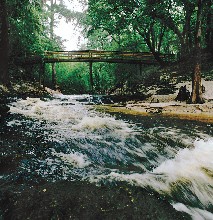
Nearby, Big Shoals Public Lands has the largest whitewater rapids
in Florida. Here the Suwannee River rushes over rock shoals to
create uncommon (for Florida) Class III rapids to dare intrepid
canoeists. The setting flashes back to a time and pace when
Timucuan and Creek tribesmen paddled the dark, tannin-tinted
waters ‘neath heavy forests filled with birds of many feather.
Downriver the paddling gets calmer, easy enough for beginners. You
can get outfitted at Spirit of the Suwannee Music Park and
Campground, near Suwannee Springs. It hosts country jamborees as
well as horseback riders, canoeists, swimmers and other lovers of
the oak-shaded setting.
Suwannee River State Park offers canoeing, hiking, camping and
swimming in a secluded limestone sinkhole. It marks the transition
between Upper and Lower Suwannee at the juncture where the
Withlacoochee River branches off. Twin Rivers State Forest’s
trails overlook both waterways and furnishes primitive camping
spots. Bluffs tower above the Suwannee at this point, where you
can also spot remains of a Confederate earthworks from the water.
Live Oak is a typical
North Central Florida hometown with a Saturday Farmers’ Market,
its namesake canopies of ancient oak trees dripping with Spanish
moss, and historic buildings holding charming shops. The Suwannee
County Historical Museum has pulled into the old railroad station
and concentrates on the Cracker way of life. Peaceful back roads
in this part of the state invite cyclists. Rentals and other
biking facilities are plentiful.
Along the Suwannee and Santa Fe rivers, a number of springs
attractions, both public and privately owned, invite visitors into
the ever-cool, 72-degree waters for swimming, inner-tubing,
snorkeling and diving. Here the land is supported by honeycombed
limestone, which forms intriguing land features such as caves,
sinkholes and rivers that seem to disappear and reappear without
warning. The springs are a magnet for wildlife – fish, turtles,
alligators, limpkins, herons and egrets – and ever since ancient
civilizations of mankind, for humans as well. |